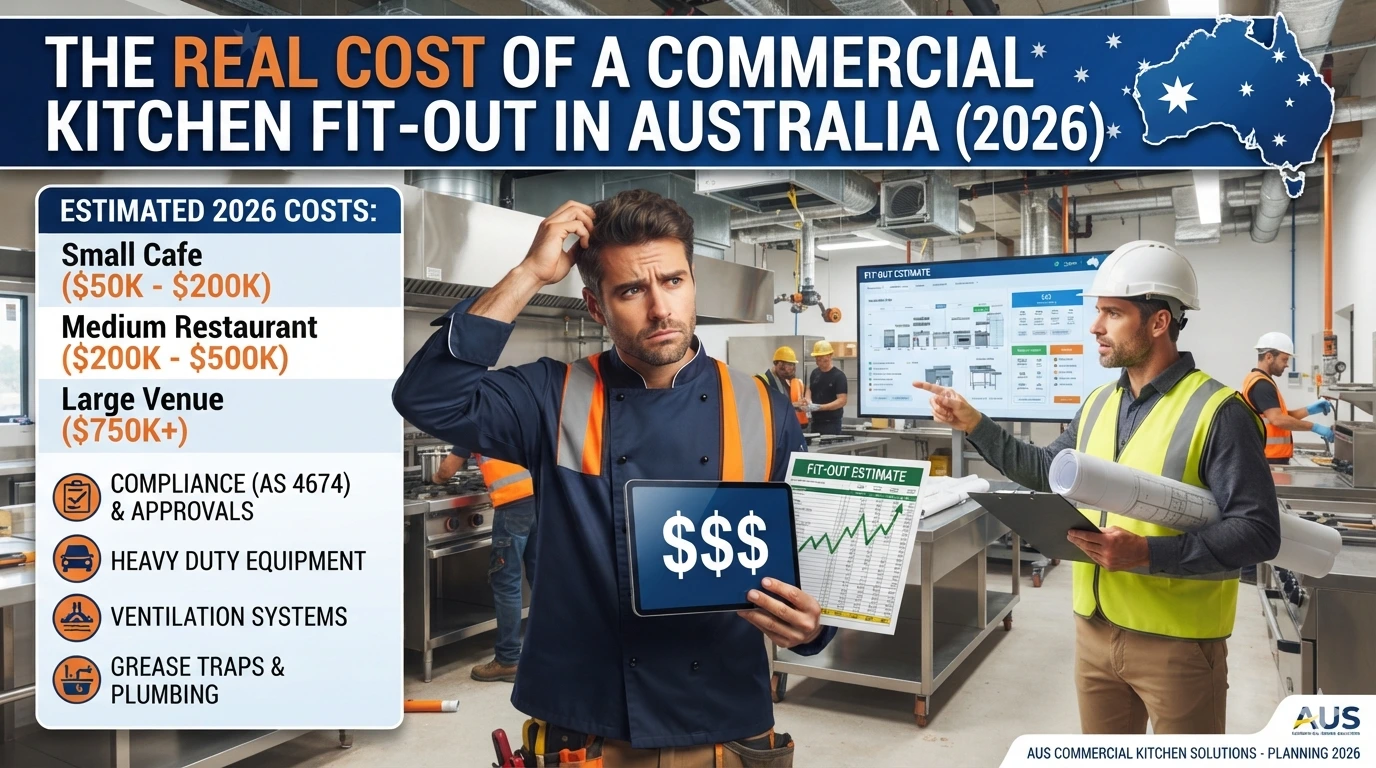
The Real Cost of a Commercial Kitchen Fit-Out in Australia (2026)
Ask three fit-out companies what a commercial kitchen costs and you will get three very different answers. That is not evasion — it is the reality of a build where the same floor plan can vary by hundreds of thousands of dollars depending on the site, the menu and the condition of the existing services. This guide gives you real 2026 Australian numbers, explains what drives them, and flags the hidden costs that catch first-time operators out.
The short answer: cost per square metre
Most commercial kitchen builds in Australia in 2026 fall into three broad tiers when measured per square metre. These figures cover construction, services and finishes for the kitchen shell — equipment is often costed separately.
| Tier | Per square metre | Typical use |
|---|---|---|
| Basic / renovation | $1,500 – $3,000 | Simple refit of a space with existing services in good condition |
| Standard / mid-range | $3,000 – $5,000 | New commercial kitchen with full ventilation and compliant finishes |
| Large / production / commissary | $5,000 – $8,000+ | High-volume, specialised or production kitchens |
What that means by venue type
Per-square-metre rates are a starting point, but total cost is easier to plan around. As a 2026 guide:
- Small café kitchen (20–40 sqm): roughly $50,000 to $200,000+ including equipment.
- Restaurant kitchen (60–100 sqm): roughly $200,000 to $500,000+.
- Large, high-volume or commissary kitchen: commonly $750,000 and above.
Note that kitchen cost per square metre tends to stay high even as floor area grows, because the expensive elements — ventilation, refrigeration, drainage and equipment — are driven by output, not floor space. A considered commercial kitchen design is what keeps that spend efficient rather than excessive.
Where the money actually goes
The single biggest line item is almost always the equipment. Refrigerators, dishwashers, combi ovens and cold rooms can account for 40 to 60 percent of the entire fit-out budget. Beyond the appliances, here are the costs that make up the rest of the build:
| Item | Indicative 2026 cost |
|---|---|
| Ventilation & exhaust system | $15,000 – $45,000 |
| Compliant kitchen flooring | from ~$200 / sqm |
| Wall coverings (stainless / tile) | $30 – $100 / sqm |
| Lighting design | $5,000 – $25,000+ |
| Design & architecture fees | 5 – 15% of project cost |
| Council approvals (DA / BA) | $5,000 – $15,000 |
| Food business licence & health certification | $1,500 – $3,000 |
| External signage | $3,000 – $15,000+ |
The hidden costs that blow budgets
The quoted build is rarely the final number. These are the surprises that most often push a project over budget — none of them show up until work begins:
- Asbestos: common in older commercial buildings and invisible until demolition starts. Removal can add $5,000 to $30,000+ with no warning.
- Electrical switchboard upgrades: if the building can't handle a commercial kitchen's power draw, an upgrade is mandatory — typically $10,000 to $30,000.
- Grease traps and drainage: installing new drainage points or grease arrest where none exist can add tens of thousands.
- Make-good clauses: the cost of returning the premises to its original state at lease end, often overlooked at signing.
This is exactly why a feasibility review before you sign matters. Reviewing completed fit-out projects and getting food and hospitality consulting early helps you spot these risks while you can still negotiate or walk away.
Why 2026 costs more than it used to
Fit-out pricing has climbed well above pre-pandemic levels. In Sydney, commercial fit-out costs rose around 4.4 percent over the past year alone. Two forces are driving it: ongoing supply-chain pressure on stainless steel and timber, and a genuine shortage of the specialised trades every kitchen needs — HVAC specialists, refrigeration mechanics, gas fitters and electricians. That trade shortage also stretches timelines: lead times on commercial kitchen equipment and imported materials now commonly run 8 to 16 weeks, so late procurement means either paying a premium or missing your opening date.
Budgeting beyond the build
The fit-out is only part of what you need funded before you can trade. A complete opening budget should also allow for loose furniture, technology and POS, signage, the lease bond and advance rent, insurances, and your launch marketing. Two practical steps here:
- If you're seeking finance or investors, build company profile materials that present your concept, costings and team professionally — lenders take a well-documented project far more seriously.
- Ring-fence a marketing budget from the start. Bringing in a specialist marketing agency to handle branding, local SEO and launch campaigns fills tables faster than trying to do it between site meetings.
All figures in this guide are indicative 2026 Australian market ranges compiled from multiple industry sources. They are not a quote. Your real cost depends on your site, your menu and your specification — only a site inspection can produce an accurate estimate.
Want a realistic number for your venue?
Petra Projects designs and delivers commercial kitchens and hospitality fit-outs across Sydney and Melbourne. Whether you're planning a small café fit-out or a full production kitchen, we'll scope it properly before you commit. Contact us for a fit-out consultation.
