Juice Restaurant Fitouts

Expert Juice Bar & Restaurant Fitouts Australia

Turning Your Healthy Vision into a High-Performing Reality

The secret to a successful juice bar isn’t just the perfect blend; it’s a floor plan that flows under pressure. At Petra Group, we specialize in end-to-end juice restaurant fitouts that balance vibrant front-of-house aesthetics with high-speed back-of-house efficiency. Whether you are launching a boutique cold-pressed juice shop or a high-volume commercial smoothie and acai bar, we design spaces that work as hard as you do. Our head office is based in Sydney, feel free to visit us: 5/62 Hume Hwy, Lansvale NSW 2166, Australia.
Our Specialist Juice Bar & Restaurant Services

Building a high-traffic juice bar requires specific technical knowledge that general shopfitters often overlook. We cover every aspect of the build:

  • Custom Production Engineering: Strategic placement of high-speed blenders, industrial cold-press juicers, and prep stations to minimize steps and maximize output during the morning rush.

  • Bespoke Display Solutions: Custom refrigerated cabinetry and open-front grab-and-go displays designed to showcase vibrant produce and drive impulse sales.

  • Advanced Drainage & Hygiene: Specialized plumbing and drainage systems designed to handle high volumes of fruit pulp and frequent wash-downs, ensuring a dry and safe workspace.

  • Council & Health Compliance: We ensure your layout meets all Australian Standards (AS 4674-2004) for food premises, expertly handling your DA or CDC approvals.

Why Workflow is Everything in Juice Bar Design

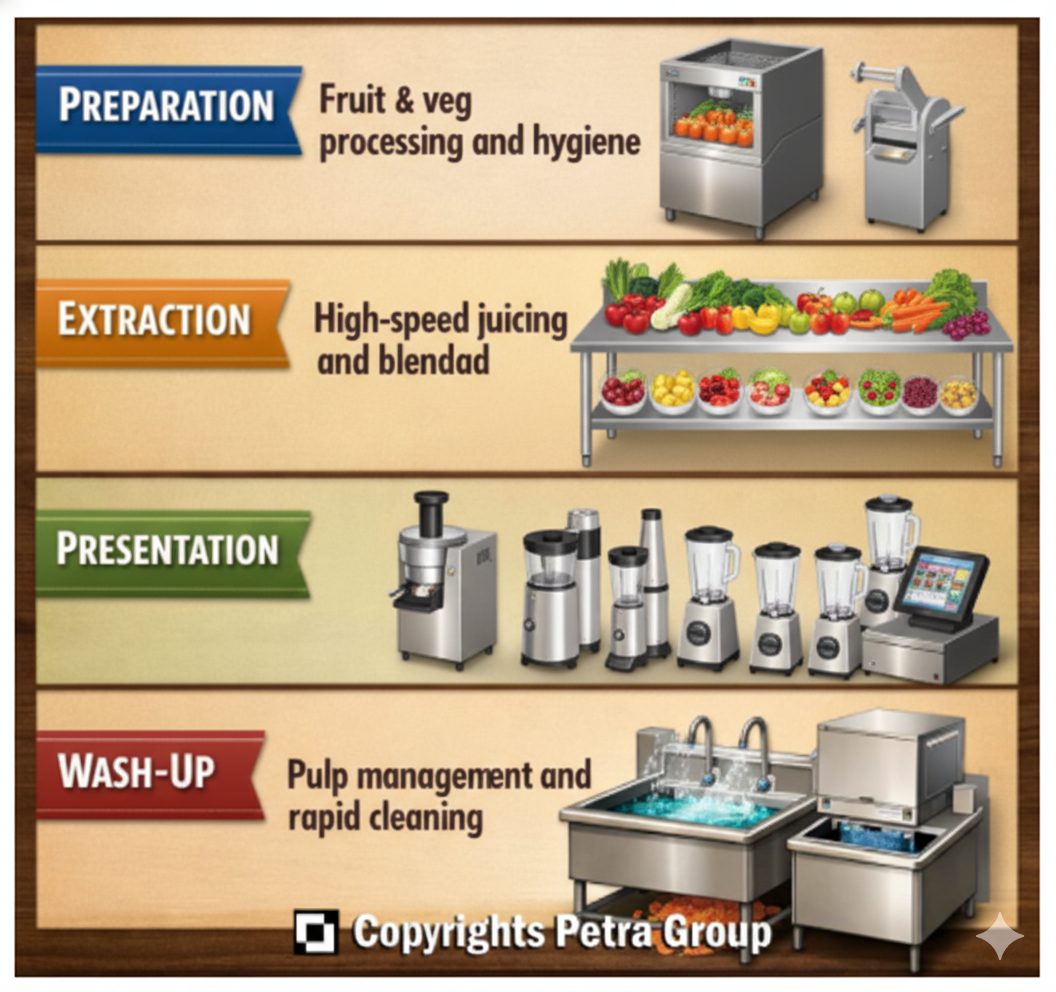
A high-traffic juice bar has unique “zones” that must be carefully managed to prevent bottlenecks, especially during the morning rush. Our designs focus on the four pillars of juice bar movement:

Zone Focus Key Equipment
Preparation Fruit & veg processing and hygiene Commercial produce washers, prep benches, peelers & slicers.
Extraction High-speed juicing and blending Industrial cold-press juicers, centrifugal juicers, high-performance blenders.
Presentation Grab-and-go and visual freshness Refrigerated display cases, acai bowl stations, POS systems.
Wash-up Pulp management and rapid cleaning High-pressure pre-rinse taps, deep sinks, commercial glasswashers.

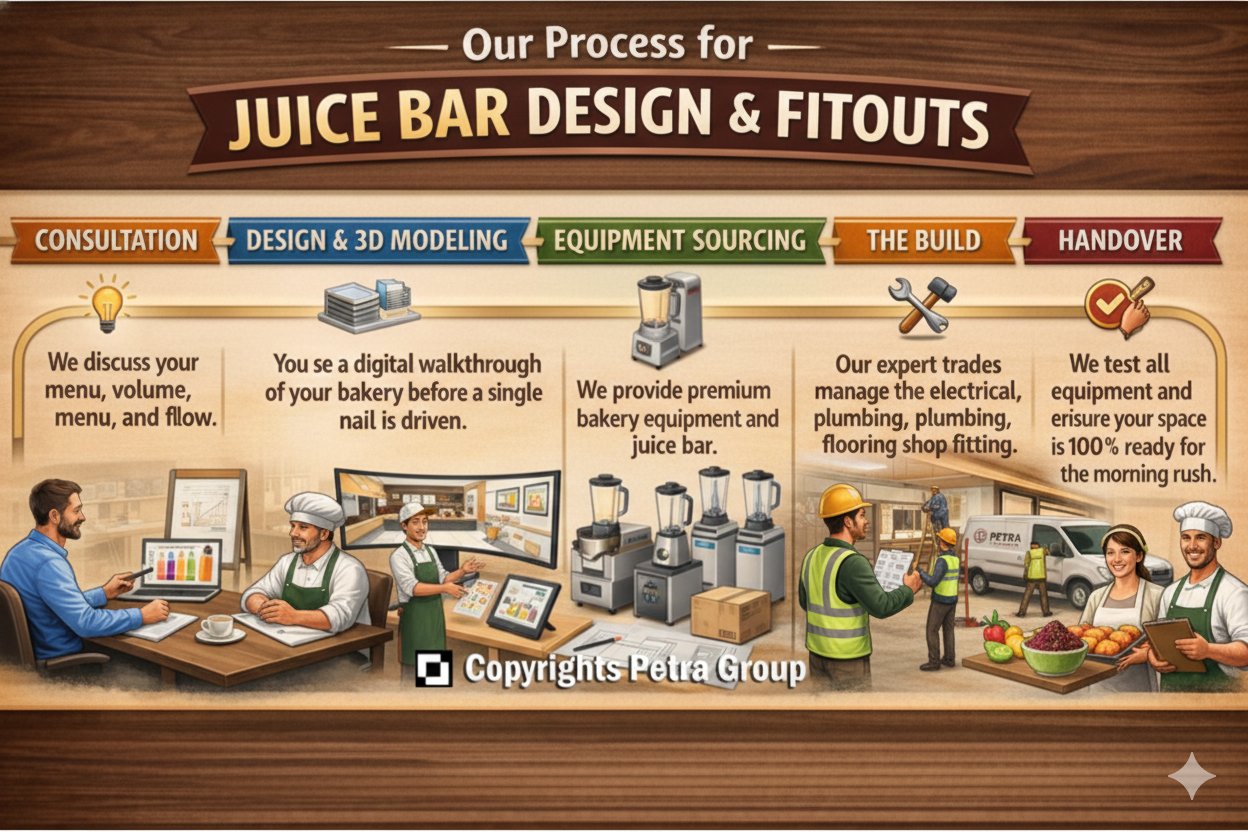
From Concept to First Pour: Our Process

With over 20 years of hands-on industry expertise, we transform the complexities of juice bar design and fitouts into a seamless, stress-free journey, handling every technical detail so you can focus on perfecting your blends.

Ready to Start Your Journey?

Don’t settle for a generic kitchen. Build a bakery that is optimized for growth, efficiency, and style.

  1. Consultation: We discuss your menu, volume, and vision.

  2. Design & 3D Modeling: You see a digital walkthrough of your bakery before a single nail is driven.

  3. Equipment Sourcing: We provide premium bakery equipment through the Petra Group network.

  4. The Build: Our expert trades manage the electrical, plumbing, and shop fitting.

  5. Handover: We test all equipment and ensure your space is 100% ready for the morning rush.

FAQ

Learn more about services

What makes juice bar design different from a standard café fitout?

While a standard café centers around the espresso machine, a high-performing juice bar is a complex technical environment. The engineering requirements are significantly more intense due to the nature of the ingredients and the high speed of service:

  • Pulp & Organic Waste Management: Unlike coffee grounds, juice production creates massive amounts of wet, heavy organic waste. We design specialized “speed holes” in benches and heavy-duty drainage systems with integrated silt pits to handle pulp efficiently without clogging pipes or slowing down your team during peak trade.

  • Acoustic Engineering: High-performance blenders are loud. A standard café layout doesn’t account for the decibel levels of multiple blenders running simultaneously. We use strategic zoning and sound-dampening materials (such as heavy-duty stone or composite surfaces) to ensure your staff can still hear orders and customers can enjoy the atmosphere.

  • High-Humidity Refrigeration: In a juice bar, your “inventory” is your décor. We install specialized high-humidity refrigeration and open-front displays that keep fruits and vegetables vibrant and crisp, rather than just cold. This significantly reduces spoilage and maximizes the visual “wow” factor for your customers.

  • Power Density & Waterproofing: Juice bars require a high concentration of high-voltage circuits in areas with constant water splashing. Our fitouts prioritize specialized electrical safety and “wash-down” friendly surfaces—such as high-grade stainless steel and non-slip epoxy flooring—that can handle the moisture levels of a busy juice bar.

Do I need a specific type of floor for a commercial juice bar?

Yes, absolutely. In a juice bar, the floor is constantly exposed to water, acidic fruit juices, and heavy foot traffic. A standard café floor will not suffice. To pass Australian Health Standards (AS 4674-2004), your flooring must meet several critical criteria:

  • Slip Resistance (R10 or R11 Rating): Juice bars are “wet areas.” We install non-slip surfaces, typically high-grade epoxy resin or commercial vinyl with grit, to ensure your staff stays safe even during spills or rapid wash-downs.

  • Acid & Enzyme Resistance: Fruit acids (like citric acid from lemons and oranges) can eat through standard grout and low-quality tiles. We provide acid-resistant flooring solutions that won’t degrade, stain, or pit over time.

  • Hygienic Coving: Health regulations require that the floor-to-wall junction is “coved.” This means the floor curves up the wall by at least 75mm, eliminating 90-degree corners where fruit pulp and bacteria can hide and grow.

  • Integrated Drainage Slopes: A flat floor is a dangerous floor in a juice bar. We engineer a subtle fall (slope) toward your floor wastes, ensuring that any spills or cleaning water move toward the drains rather than pooling under benches.

How do you manage heat and ventilation in a small juice bar space?

While you aren’t running large ovens, a juice bar generates a surprising amount of heat and moisture that can quickly make a small space uncomfortable. We manage this through three key engineering strategies:

  • Appliance Heat Extraction: High-performance blenders and centrifugal juicers have powerful motors that vent heat from the bottom or back. In a confined space, this can raise the temperature behind the counter by 5–8°C. We design cabinetry with integrated ventilation or “breathable” shelving to prevent motor burnout and keep the work zone cool.

  • Humidity & Condensation Control: Washing hundreds of kilos of produce and frequent equipment rinsing creates high humidity. Without proper mechanical ventilation, this leads to condensation on windows and potential mould growth. We install balanced exhaust systems that pull moist air out while bringing fresh, filtered air in.

  • Odour & Ozone Management: While fresh juice smells great, fermenting fruit pulp in a bin does not. We ensure the ventilation system provides enough “air changes per hour” to keep the air smelling crisp and clean, ensuring the natural aroma of fresh citrus dominates the customer experience.

  • Refrigeration Exhaust: Commercial fridges and ice machines vent significant heat into the room. For small spaces, we often recommend “remote motors” (placing the heat-generating compressors outside or on the roof) to keep your front-of-house quiet and cool for customers.

Can you help with the DA/CDC approval for a juice bar?

Yes, navigating Australian council regulations is one of the most critical parts of a juice bar project. Because you are handling fresh food and generating organic waste, the requirements are more stringent than a standard retail shop. We handle the entire compliance journey for you:

  • DA (Development Application) & CDC (Complying Development Certificate): We prepare all the necessary architectural plans, site analysis, and Statement of Environmental Effects required by your local council or private certifier.

  • Health & Hygiene Compliance (AS 4674-2004): Juice bars are high-risk zones for health inspectors due to the handling of raw fruits and vegetables. We ensure your plans meet every standard, from the specific placement of hand-wash basins to the “coving” of floors and the use of non-porous surfaces.

  • Hydraulic & Drainage Plans: Councils in Australia are very strict about how juice bars handle “trade waste.” We design and submit plans for grease traps (if you serve food/acai) or specialized silt pits and sediment traps required to prevent fruit pulp from entering the public sewer system.

  • Mechanical Ventilation & Noise Reports: If your juice bar is located in a residential-commercial mixed building, we provide the engineering certifications needed to prove your high-speed blenders and refrigeration motors won’t exceed noise level limits.

Can I integrate my retail area and production in an "Open Plan" juice bar?

Absolutely. In the Australian market, “theatre” is a massive selling point. Customers love seeing fresh oranges being pressed and vibrant acai bowls being crafted. However, an open-plan juice bar requires careful design to separate the “show” from the “mess”:

  • Strategic Zoning: We design the “Front-of-House” prep area to be visually stunning—using glass-shielded fruit displays and clean stainless steel or stone surfaces. The “messy” work, like heavy peeling, bulk washing, and pulp disposal, is tucked into a back-of-house “prep zone” to maintain a premium look for customers.

  • Sneeze Guards & Hygiene Barriers: To comply with AS 4674-2004, any open food or drink preparation must be protected. We install custom-toughened glass sneeze guards that are high enough to protect the produce but low enough to allow for a friendly interaction between your staff and customers.

  • Splash Management: Juicing is a “splashy” business. An open-plan design must account for juice spray and pulp flying from centrifugal juicers. We use high-clearance glass barriers and specific bench depths to ensure the customer side of the counter remains spotless and dry.

  • Acoustic Separation: In an open-plan layout, the sound of blenders can drown out the music and the POS area. We often “recess” the blending stations into the benchtop or use sound-deadening acrylic hoods so you can maintain the open-plan vibe without the industrial noise.

Visit us

5/62 Hume Hwy, Lansvale NSW 2166, Australia

See Directions

Call us

02 9723 4555