Japanese Restaurant Fitouts

Expert Japanese Restaurant Design & Fitouts Australia

Turning Your Culinary Precision into a High-Performing Reality

The secret to a successful Japanese restaurant isn’t just the freshness of the fish; it’s a floor plan that flows with Zen-like efficiency. At Petra Group, we specialise in end-to-end Japanese restaurant fitouts that balance minimalist front-of-house aesthetics with high-performance back-of-house kitchen engineering. Whether you are launching an intimate Omakase sushi bar or a high-volume commercial Ramen house, we design spaces that work as hard as you do. Our head office is based in Sydney, feel free to visit us: 5/62 Hume Hwy, Lansvale NSW 2166, Australia.
Our Specialist Japanese Restaurant Services

Building a Japanese restaurant requires specific technical knowledge that general shopfitters often overlook. We cover every aspect of the build:

  • Custom Kitchen Engineering: Strategic placement of high-output noodle cookers, Teppanyaki grills, and dedicated sushi preparation zones to ensure a seamless workflow and culinary precision.

  • Bespoke Zen Dining & Sushi Bars: Custom-built sushi counters and minimalist joinery designed to showcase the chef’s craft while creating an authentic, tranquil atmosphere for your guests.

  • Specialized Ventilation & Water Filtration: High-performance exhaust systems for heavy steam and smoke management, alongside advanced water filtration systems essential for authentic dashi and rice quality.

  • Council & Health Compliance: We ensure your layout meets all Australian Standards (AS 4674-2004) for food premises, specifically managing the strict temperature control requirements for raw seafood, while handling your DA or CDC approvals.

.

Why Workflow is Everything in Japanese Restaurant Design

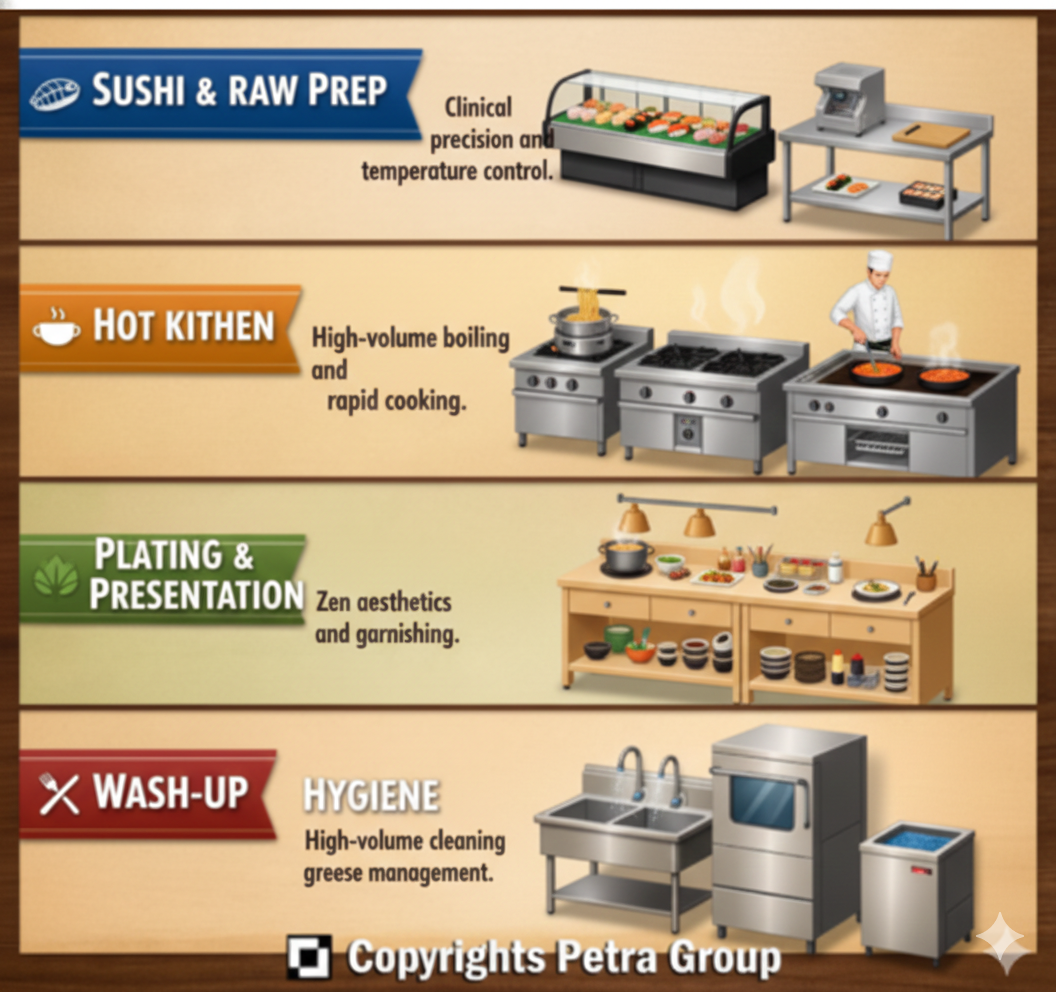
A Japanese restaurant has unique “zones” that must be carefully managed to prevent bottlenecks and maintain culinary integrity. Our designs focus on the four pillars of Japanese kitchen movement:

Zone Focus Key Equipment
Sushi & Raw Prep Clinical precision and temperature control. Sushi cabinets, refrigerated prep benches, rice shakers.
Hot Kitchen High-volume boiling and rapid cooking. Noodle cookers, heavy-duty burners, Teppanyaki grills.
Plating & Presentation Zen aesthetics and garnishing. Custom plating stations, overhead warming lamps, garnish prep units.
Wash-up & Hygiene High-volume cleaning and grease management. High-temp dishwashers, deep sinks, commercial grease traps.

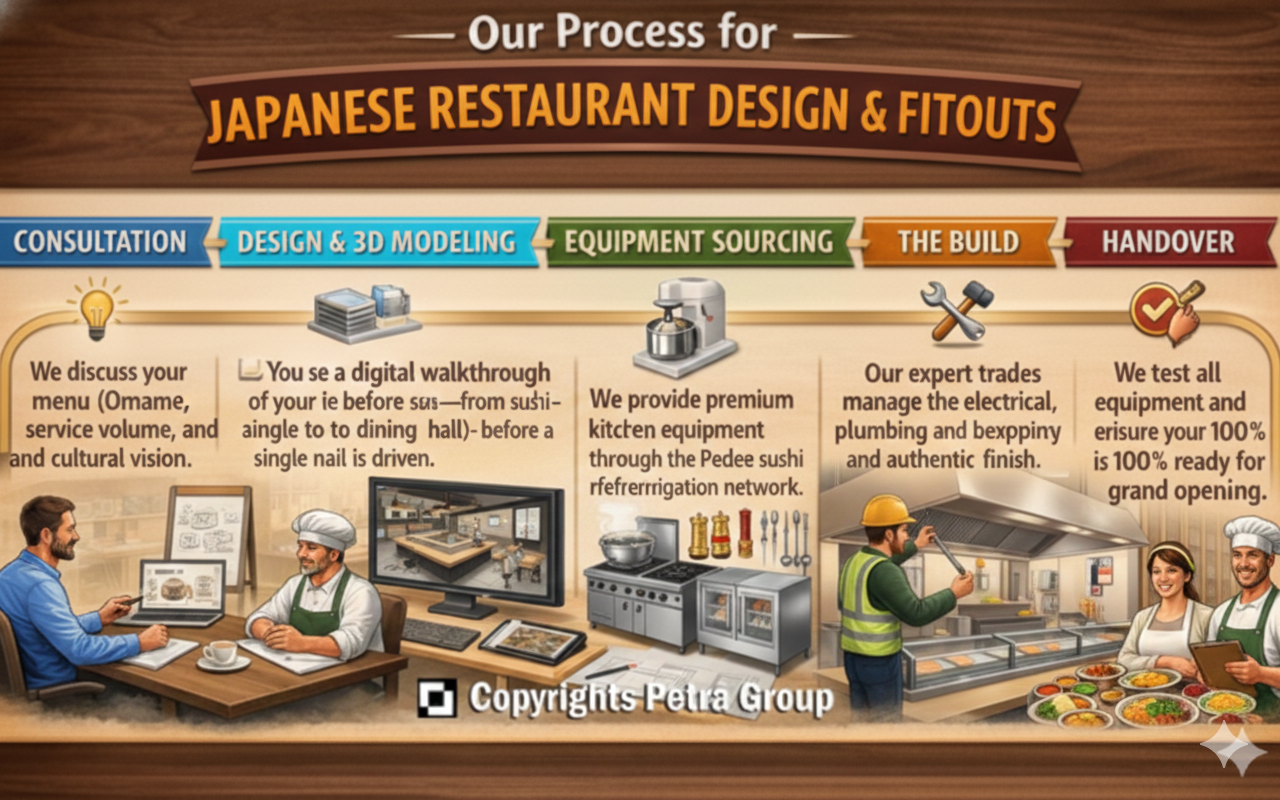
From Concept to First Service: Our Process

With over 20 years of hands-on industry expertise, we transform the complexities of Japanese restaurant design and fitouts into a seamless, stress-free journey. We handle every technical detail—from precision kitchen engineering to minimalist interior aesthetics—so you can focus on perfecting your culinary craft.

Ready to Start Your Journey?

Don’t settle for a generic kitchen. Build a Japanese restaurant that is optimized for precision, efficiency, and Zen-inspired style.

  • Consultation: We discuss your menu (from Omakase to Ramen), service volume, and cultural vision.

  • Design & 3D Modeling: You see a digital walkthrough of your restaurant—from the sushi bar to the dining hall—before a single nail is driven.

  • Equipment Sourcing: We provide premium Japanese cooking equipment, including noodle boilers and sushi refrigeration, through the Petra Group network.

  • The Build: Our expert trades manage the specialized electrical, plumbing, and bespoke joinery for an authentic finish.

  • Handover: We test all equipment and ensure your space is 100% ready for your grand opening service.

FAQ

Learn more about services

What makes Japanese restaurant design different from a standard café fitout?

Unlike a standard café, a Japanese restaurant requires a complex balance of opposing environments: the “cold” zone for ultra-fresh sushi and the “hot” zone for high-intensity ramen or grill cooking.

Japanese fitouts demand specialized water filtration for authentic dashi, high-velocity extraction for heavy steam, and precise workflow zoning to prevent cross-contamination between raw seafood and cooked dishes. Additionally, the aesthetic often requires bespoke joinery and minimalist finishes that must be both visually tranquil and commercially durable—a level of precision that goes far beyond a typical café setup.

Do I need a specific type of floor for a commercial Japanese restaurant?

Yes, absolutely. In a Japanese kitchen, the flooring must handle two distinct challenges: the heavy steam/moisture from ramen boiling stations and the oils/grease from tempura or teppanyaki frying.

Under Australian Standards (AS 4674-2004), the flooring must be non-absorbent, slip-resistant, and easy to clean. We typically recommend:

  • Epoxy Resin with Slip-Resistance: Ideal for high-traffic hot kitchens where grease and water are constant.

  • Coved Skirting: Essential for all commercial kitchens; the floor must curve up the wall to eliminate 90-degree corners where bacteria and food particles (like rice or flour) can hide.

  • Architectural Finishes for Dining Areas: For the front-of-house, we often use high-durability timber-look tiles or polished concrete that maintains the minimalist Japanese aesthetic while being robust enough for a busy restaurant.

How do you manage heat and ventilation in a compact Japanese kitchen space?

Japanese kitchens, especially Ramen bars and Yakiniku/Teppanyaki spots, generate an incredible amount of concentrated heat and steam in very tight spaces. Proper management is critical for both staff comfort and customer experience. We handle this through:

  • Custom High-Velocity Hoods: We design bespoke extraction systems specifically for high-steam equipment like noodle boilers and heavy-duty stockpot burners to prevent the dining area from becoming humid.

  • Spot Cooling & Airflow Direction: In small spaces, we strategically place air supply vents to create “cool zones” for chefs, ensuring that air conditioning doesn’t fight against the exhaust hoods.

  • Induction Technology: Where space is extremely limited, we recommend high-efficiency induction cooktops. They provide the same precision as gas but release significantly less ambient heat into the kitchen.

  • Efficient Make-Up Air Systems: To prevent doors from whistling or becoming hard to open (negative pressure), we install systems that replace the air being sucked out by the exhaust, keeping the atmosphere balanced and comfortable for your guests.

Can you help with the DA/CDC approval for a Japanese restaurant?

Yes, we handle the entire approval process. Obtaining a Development Application (DA) or Complying Development Certificate (CDC) for a Japanese restaurant involves specific requirements that differ from other food businesses:

  • Trade Waste & Grease Traps: Japanese kitchens, particularly those serving Ramen or Tempura, produce significant grease. We ensure your hydraulic plans meet local council and Sydney Water (or relevant authority) requirements for grease interceptor traps.

  • Acoustic & Odour Privacy: If your restaurant features Teppanyaki or heavy grilling, councils often require specific reports to ensure smoke and noise do not affect neighbouring properties. We manage these specialist consultant reports for you.

  • AS 4674-2004 Compliance: We design every detail—from the coved flooring to the stainless steel wall cladding—to ensure you pass the final health inspection with ease.

  • Zoning & Seating: We maximise your floor space while ensuring you comply with accessibility (disabled access) and fire safety regulations required for a commercial hospitality license.

Can I integrate my dining area and kitchen in an "Open Plan" Japanese restaurant?

Absolutely. In Japanese dining, the “theatre” of food preparation—whether it’s the precise slicing of sashimi or the flair of a Teppanyaki grill—is a key part of the customer experience. However, an open-plan Japanese kitchen requires much smarter engineering than a standard closed kitchen:

  • Acoustic & Sensory Balance: While guests love to see the chef, they don’t want to be overwhelmed by the noise of commercial dishwashers or the intense hiss of high-pressure burners. We use strategic zoning and “low-noise” equipment placement to maintain a tranquil Zen atmosphere.

  • Advanced Odour & Steam Capture: In an open plan, your exhaust system must be flawless. We install high-performance, low-hanging hoods or “induction-friendly” extraction to ensure that steam from noodle cookers and smoke from grills never reach your customers’ seating area.

  • Sleek Aesthetics: Since your kitchen is part of the décor, we use premium finishes like stainless steel, stone, or Shou Sugi Ban (charred timber) accents that are both food-safe and visually stunning.

  • Compliance & Safety: We ensure that the barrier between your “theatre” (the prep counter) and the customers meets all Australian health and safety regulations, including sneeze guards or raised counters where necessary.

Visit us

5/62 Hume Hwy, Lansvale NSW 2166, Australia

See Directions

Call us

02 9723 4555