Indian Restaurant Fitouts

Expert Indian Restaurant Design & Fitouts Australia

Turning Your Culinary Heritage into a High-Performing Reality

The secret to a successful Indian restaurant isn’t just the perfect blend of spices; it’s a floor plan that flows. At Petra Group, we specialise in end-to-end Indian restaurant fitouts that balance the vibrant aesthetics of the front-of-house with the intense industrial efficiency required in the back-of-house.

From installing high-heat Tandoor stations and heavy-duty ventilation systems to designing elegant dining areas for fine dining, we design spaces that work as hard as you do. Whether you are launching a quick-service chaat hub or a high-end Indian banquet hall, our team understands the unique workflow of subcontinental cuisine.
Our Specialist Indian Restaurant Services

Building an authentic Indian restaurant requires specific technical knowledge that general shopfitters often overlook. From managing high-intensity heat to complex spice-prep workflows, we cover every aspect of the build:

  • Custom Kitchen Engineering: Strategic placement of high-output burners, heavy-duty Tandoor stations, and bulk-prep areas to minimize steps and maximize output during peak banquet hours.

  • Bespoke Dining & Bar Layouts: Custom interior design that balances traditional cultural aesthetics with modern comfort, designed to enhance the guest experience and drive repeat bookings.

  • Specialized Ventilation & Gas: High-performance exhaust systems and grease traps engineered to handle the intense smoke, heat, and oil-heavy steam of traditional Indian cooking.

  • Council & Health Compliance: We ensure your layout meets all Australian Standards (AS 4674-2004) for food premises, handling your DA or CDC approvals to ensure a stress-free launch.

Why Workflow is Everything in Indian Restaurant Design

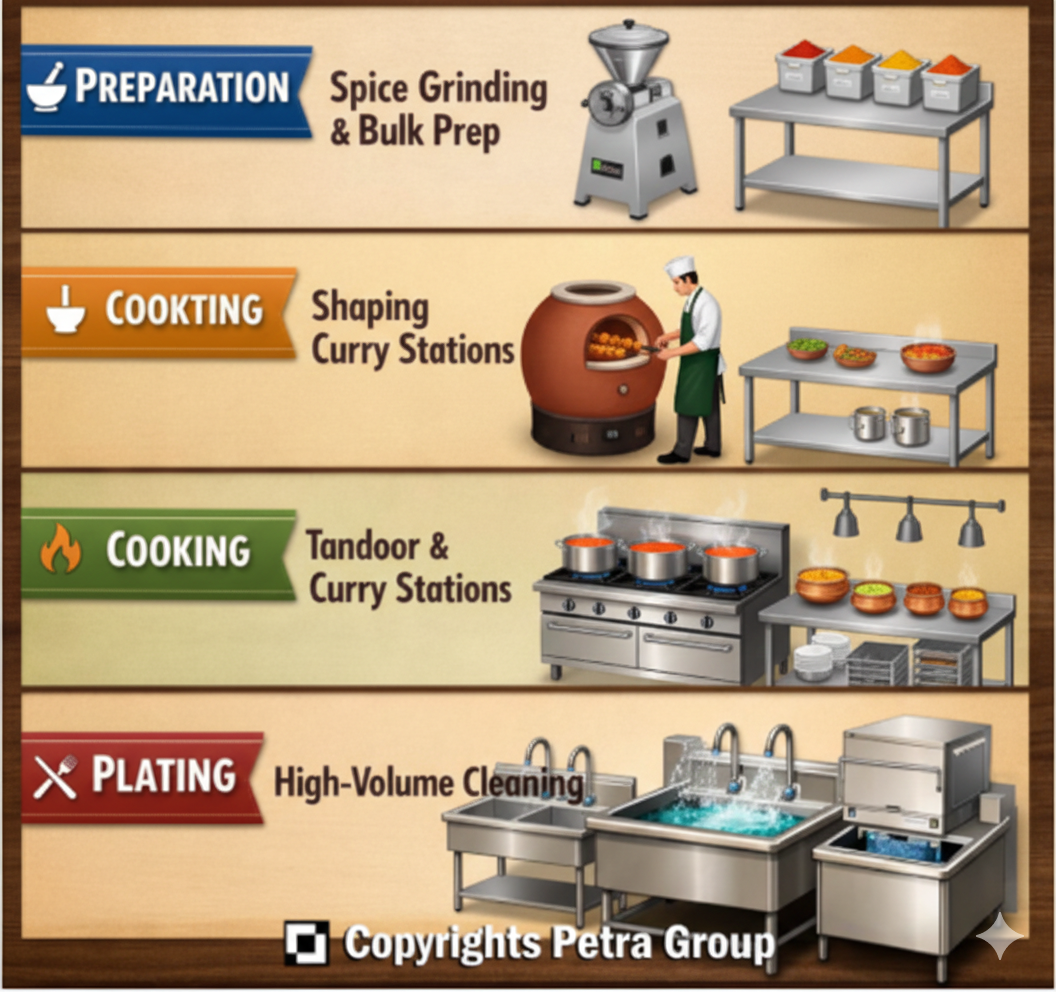
An Indian restaurant has unique “zones” that must be carefully managed to prevent bottlenecks, especially during high-volume dinner rushes and banquet service. Our designs focus on the four pillars of Indian culinary movement:

  • The Tandoor & Grill Zone: Centralising high-heat equipment with dedicated ventilation to ensure chef safety and rapid order turnaround.

  • The Curry & Sauté Station: Optimising the placement of high-pressure burners and spice wells to allow for seamless multi-tasking and pan management.

  • Prep & Spice Blending Hubs: Creating dedicated areas for bulk vegetable prep and complex spice grinding that stay clear of the main cooking line.

  • The Service Pass & Expediting: Designing a wide, efficient “pass” area to handle the heavy volume of shared platters, thalis, and hot breads moving from the kitchen to the dining room.

Zone Focus Key Equipment
Preparation Bulk prep, spice grinding, and marinating Heavy-duty grinders, spice wells, and large prep benches
Tandoor & Grill High-heat roasting and traditional bread baking Clay or stainless steel Tandoor ovens and charcoal grills
Main Cooking Curry production and high-pressure sautéing High-output gas burners, brat pans, and stockpot burners
Wash-up High-volume cleaning for heavy pots and pans Deep pot sinks, pre-rinse sprays, and commercial pass-through dishwashers

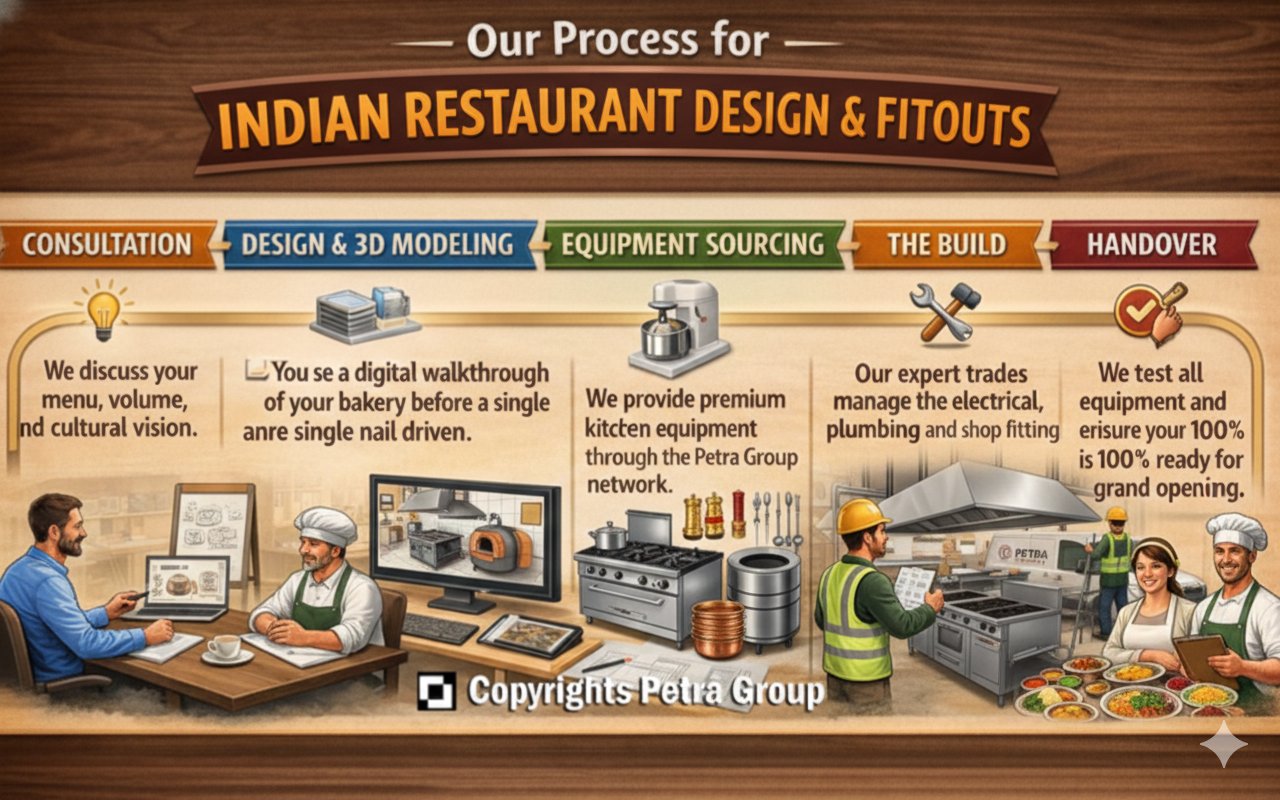
From Concept to First Service: Our Process

With over 20 years of hands-on industry expertise, we transform the complexities of Indian restaurant design and fitouts into a seamless, stress-free journey. From managing high-intensity kitchen requirements to creating authentic cultural atmospheres, we handle every technical detail—so you can focus on perfecting your menu and hospitality.

Ready to Start Your Journey?

Don’t settle for a generic kitchen. Build an Indian restaurant that is optimised for growth, efficiency, and authentic style.

  • Consultation: We discuss your specific menu, service volume, and cultural vision for the space.

  • Design & 3D Modelling: You see a digital walkthrough of your Indian restaurant—from the tandoor placement to the dining layout—before a single nail is driven.

  • Equipment Sourcing: We provide premium commercial kitchen equipment, including specialised Indian cooking ranges, through the Petra Group network.

  • The Build: Our expert trades manage the high-pressure gas lines, heavy-duty plumbing, and custom shopfitting required for a high-output kitchen.

  • Handover: We test all equipment, including ventilation and gas systems, to ensure your space is 100% ready for the grand opening rush.

FAQ

Learn more about services

What makes Indian restaurant design different from a standard café fitout?

Indian restaurant design is significantly more complex than a standard café fitout due to the intensity of the cooking environment. Unlike a café that primarily handles light cooking and coffee, an Indian kitchen must be engineered for:

  • High-Heat Management: The use of Tandoor ovens and high-pressure burners generates extreme ambient temperatures that require specialised heat-shielding and heavy-duty cooling.

  • Advanced Ventilation: Indian cuisine produces high volumes of smoke and oil-laden steam. A standard café exhaust is insufficient; we install high-performance extraction systems to keep the air clear and meet Australian safety standards.

  • Specific Utility Demands: From high-capacity gas lines for large burner ranges to oversized grease traps for oil-heavy cleanup, the infrastructure requirements are much more robust than a typical café.

  • Cultural Ambience: Unlike the minimalist style of many modern cafés, an Indian restaurant often requires a balance of vibrant cultural aesthetics with durable, high-traffic flooring and furniture.

Do I need a specific type of floor for a commercial Indian restaurant?

Yes, flooring in an Indian restaurant must be significantly more durable than standard residential or retail flooring. Due to the high-volume use of oils, spices (which can stain), and heavy stockpots, your flooring must meet three specific criteria:

  • Slip Resistance (R10 or R11 Rating): Indian kitchens often deal with oil-laden steam and accidental spills. We install non-slip commercial vinyl or epoxy flooring that meets Australian safety standards to prevent staff accidents.

  • Heat Resistance: The area around a Tandoor oven can reach extreme temperatures. Your flooring must be able to withstand this radiant heat without warping or cracking.

  • Coving for Hygiene: To comply with AS 4674-2004, the flooring must be “coved” (curved up the wall) at the edges. This eliminates 90° corners where spice dust, grease, and food particles could accumulate, making the kitchen easy to wash down.

  • Stain Resistance: Given the heavy use of turmeric and other vibrant spices, we recommend high-grade epoxy coatings that are non-porous and resistant to deep staining.

How do you manage heat and ventilation in a high-intensity Indian kitchen?

Managing heat is the biggest challenge in an Indian restaurant fitout, especially when operating Tandoor ovens which can reach temperatures over 400°C. We use a multi-layered approach to ensure your kitchen remains safe and your staff stay productive:

  • Dedicated Tandoor Extraction: We design custom, high-velocity exhaust hoods specifically for the Tandoor station to capture concentrated smoke and radiant heat at the source before it spreads to the rest of the kitchen.

  • High-Volume Air Change Rates: Indian kitchens require a much higher rate of air exchange than standard cafés. We calculate the exact “Make-Up Air” (MUA) needed to replace the air being sucked out by the exhaust, preventing negative pressure and ensuring a constant flow of fresh air.

  • Heat Shielding & Insulation: We install commercial-grade fire-rated splashbacks and thermal insulation behind heavy-duty cooking ranges to protect your walls and reduce the ambient temperature in the prep zones.

  • Strategic Layout: By placing high-heat equipment (Tandoor, Grill, and Curry Burners) under a single, powerful extraction canopy and separating them from the refrigeration and prep zones, we prevent your fridges from working overtime and failing.

Can you help with the DA/CDC approval for an Indian restaurant?

Absolutely. Navigating council approvals is often the most stressful part of an Indian restaurant fitout, especially given the strict regulations surrounding high-capacity grease traps and exhaust emissions. At Petra Group, we manage the entire compliance process for you:

  • DA (Development Application) & CDC (Complying Development Certificate): We handle the submission of all necessary architectural plans and technical specifications to your local council or private certifier.

  • Health & Safety Compliance: We ensure your kitchen layout strictly adheres to AS 4674-2004 (Design, construction and fitout of food premises), ensuring a smooth inspection from health officers.

  • Specialised Approvals: We coordinate the specific requirements for Indian restaurants, such as:

    • Water Authority (Sydney Water/Local Water): For the installation of high-capacity grease traps to handle oil-heavy waste.

    • Fire Safety: Ensuring high-heat Tandoor stations meet all fire safety and clearance regulations.

    • Acoustic & Odour Reports: Managing the impact of high-powered ventilation systems on neighbouring properties.

Can I integrate my dining area and kitchen in an "Open Kitchen" Indian restaurant?

Yes, an “Open Kitchen” or “Show Kitchen” is a fantastic way to showcase the skill of your chefs—especially the theatrical art of stretching naan bread and cooking in a Tandoor. However, for an Indian restaurant, this requires much more careful engineering than a standard café to ensure the guest experience isn’t compromised by smoke or noise:

  • High-Performance “Air Curtains”: To prevent the intense smells of spices and smoke from entering the dining area, we use advanced extraction and “air curtain” technology that creates an invisible barrier between the kitchen and the guests.

  • Aesthetic Tandoor Integration: We can design a feature Tandoor station with glass partitioning or decorative ventilation hoods, allowing guests to watch the cooking process while staying protected from the high radiant heat.

  • Noise Control: Indian kitchens are busy and often loud. We use acoustic dampening materials and strategic equipment placement to ensure the “clatter” of pans doesn’t overpower the dining room’s ambience.

  • Compliance with Aesthetics: We ensure that even with an open layout, your kitchen remains 100% compliant with AS 4674-2004 hygiene standards, using materials that look beautiful for the customers but are easy to deep-clean for your staff.

Visit us

5/62 Hume Hwy, Lansvale NSW 2166, Australia

See Directions

Call us

02 9723 4555